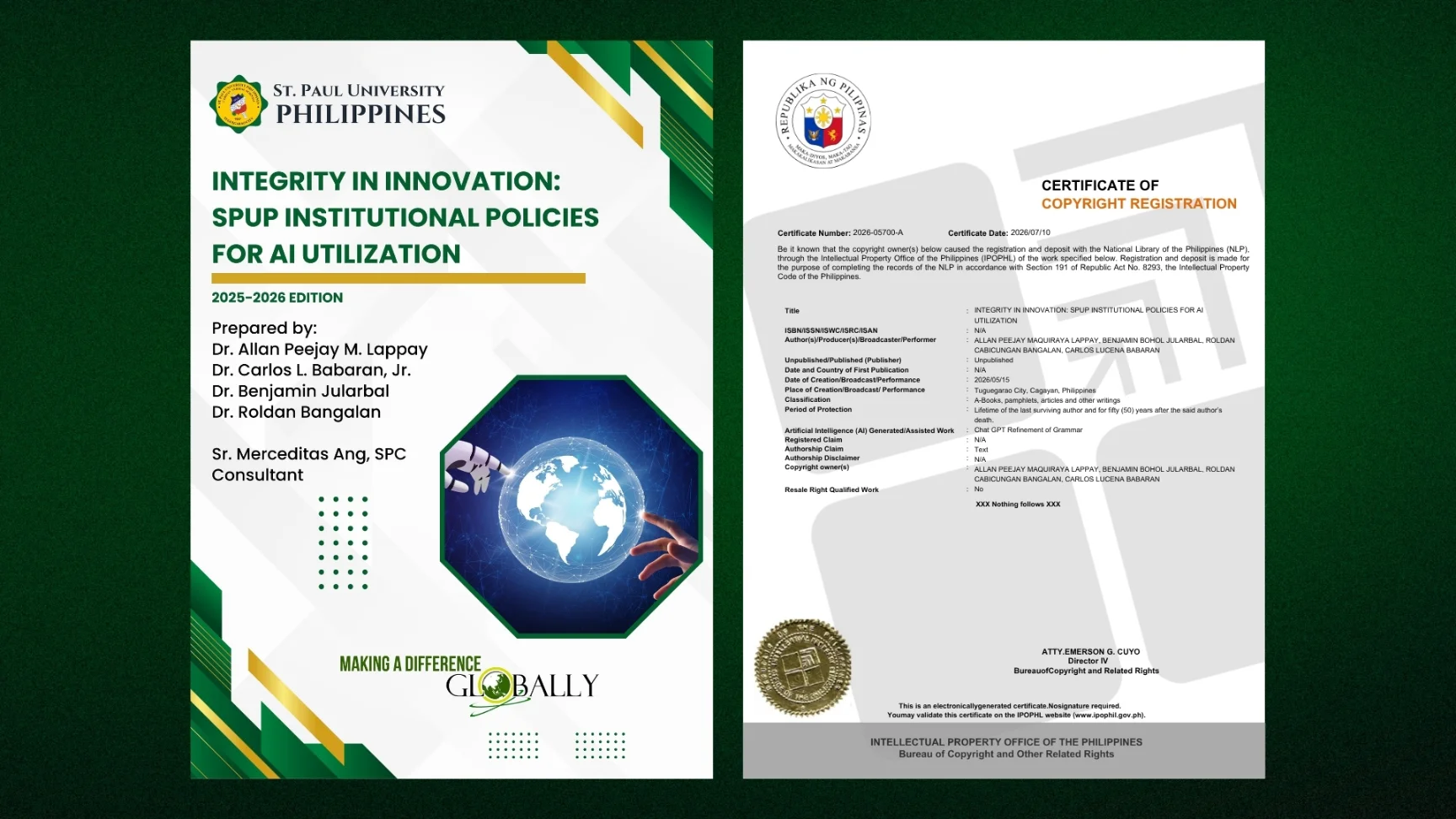
July 20, 2026 — In its continuing pursuit of ethical digital scholarship and innovation, St. Paul University Philippines (SPUP) has officially secured a Certificate of Copyright Registration from the Intellectual Property Office of the Philippines (IPOPhl) for its institutional manual, Integrity in Innovation: SPUP Institutional Policies for AI Utilization. The manual was collaboratively authored by Dr. Allan Peejay M. Lappay (Director, Alumni, External Relations and Advocacies), Dr. Benjamin Jularbal (Director, Center for Planning, Research, Innovations and New Technologies), Dr. Carlos L. Babaran, Jr. (Director, Information and Communications Technology), and Dr. Roldan Bangalan (Dean, School of Arts, Sciences and Teacher Education), with Sr. Merceditas Ang, SPC (University President) serving as project consultant. Through the successful completion of the IPOPhl registration process, SPUP has secured legal protection for this pioneering work and strengthened its position as a leader in responsible and faith-centered artificial intelligence governance in higher education.
The newly copyrighted manual provides a comprehensive framework for the ethical and responsible use of artificial intelligence across academic, research, and administrative functions. While recognizing the transformative potential of AI in enhancing efficiency, innovation, and decision-making, the policy firmly establishes that technology must remain subordinate to human intellect, conscience, and moral responsibility. Grounded in the Paulinian Core Values of Christ-centeredness, Commission, Charity, Charism, and Community, the framework ensures that technological advancement is harmonized with Catholic educational principles, human dignity, and ethical accountability.
To foster innovation while preserving academic integrity, the manual outlines appropriate and constructive uses of AI for teaching, learning, and research. Faculty members and students are encouraged to utilize AI as supportive tools for language enhancement, idea generation, and data organization while maintaining the authenticity of individual academic work. The policy also aligns institutional research and publication practices with internationally recognized standards established by the Committee on Publication Ethics (COPE) and the International Committee of Medical Journal Editors (ICMJE), emphasizing that authorship, intellectual contribution, and scholarly accountability remain exclusively human responsibilities.
The framework further strengthens SPUP’s commitment to data privacy, intellectual property protection, and quality assurance. In compliance with the Data Privacy Act of 2012 (RA 10173), sensitive institutional information, including student records, research manuscripts, examination materials, and financial documents must be processed only through authorized university-approved systems. To uphold academic integrity, the Center for Planning, Research, Innovations and New Technologies (CPRINT) and the Quality Assurance Office utilize verification tools such as Turnitin, with recommended originality thresholds of 10% for assessment-related outputs and 20% for research and publication materials. The policy likewise requires transparent disclosure of AI-assisted work, ensuring that all outputs clearly identify the tools used and affirm that final analyses, interpretations, and conclusions have been reviewed and validated by human authors.